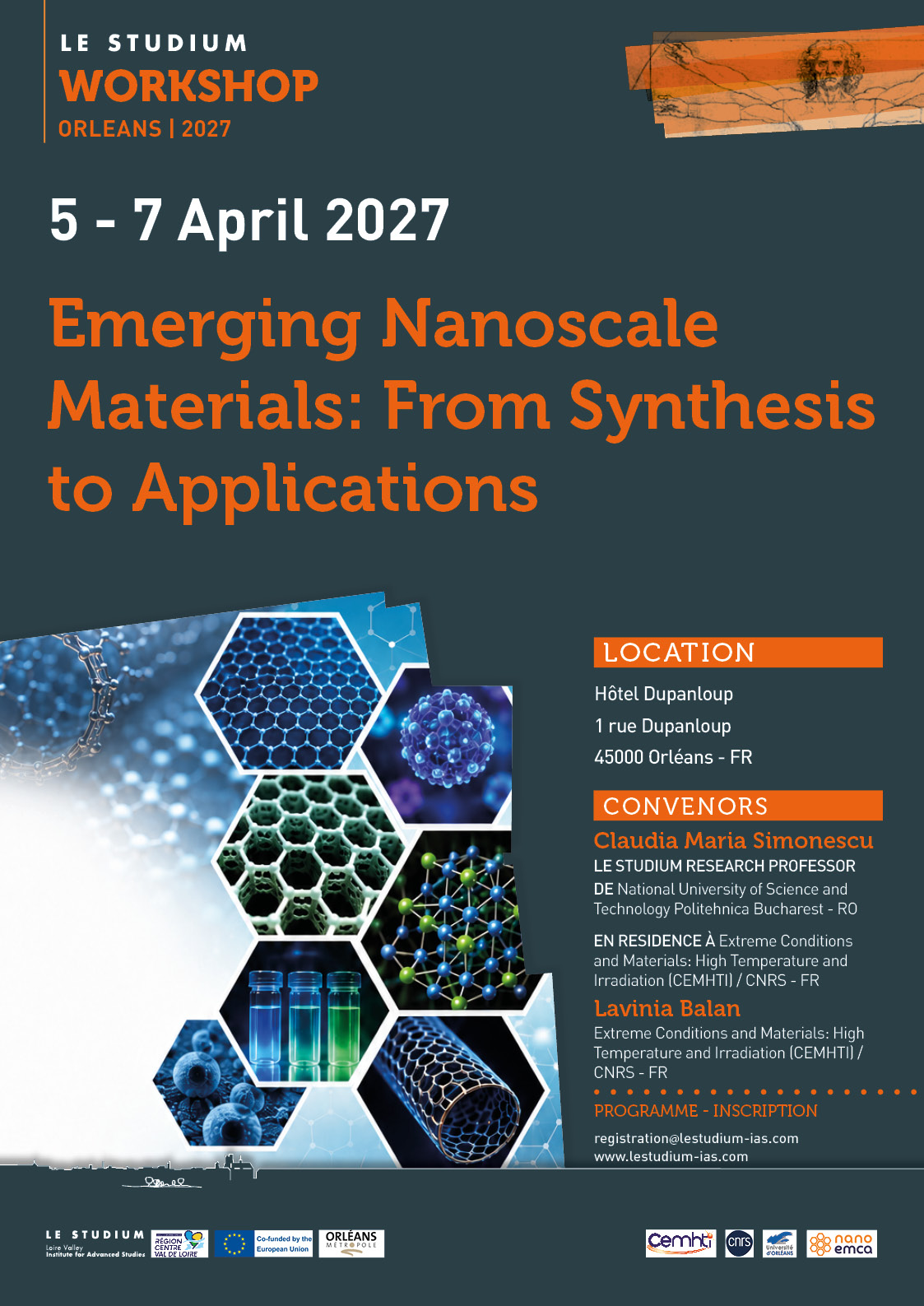
Emerging Nanoscale Materials: From Synthesis to Applications

April 05, 2027 - April 07, 2027
Workshop

Hôtel Dupanloup
1 rue Dupanloup
45000 Orléans
France

Presentation

The International Workshop on Emerging Nanoscale Materials: From Synthesis to Applications  aims to bring together PhD students, early-career researchers, scientists, and academics to exchange knowledge and discuss latest advances in nanoscience and nanotechnology. The workshop will provide a multidisciplinary forum covering the design, synthesis, characterization and applications of innovative nanoscale materials for addressing current technological and societal challenges.

Nanoscale materials have revolutionized multiple fields due to their unique structural, optical, electronic, magnetic, and catalytic properties. Recent developments in nanomaterials such as metal oxide nanoparticles, graphene-based materials, carbon nanotubes, MXenes, quantum dots, and hybrid nanocomposites have opened new opportunities for addressing global challenges in energy, environmental sustainability, healthcare, electronics, and advanced manufacturing.

The scientific program will feature keynote lectures, invited talks, oral and poster presentations, as well as interactive networking sessions aimed at fostering scientific exchange and interdisciplinary collaboration. Particular attention will be given to sustainable nanomaterials, AI-assisted materials design, advanced energy technologies, and next-generation nanostructures for environmental and biomedical applications.

The primary objective of the workshop is to encourage interdisciplinary collaboration, foster scientific innovation, and provide young researchers with opportunities to present their work, receive expert feedback, and build professional networks. Through knowledge sharing and scientific exchange, the workshop seeks to bridge the gap between fundamental research and practical applications, contributing to the advancement of sustainable technologies based on emerging nanoscale materials.

Target Audience: doctoral researchers, postdoctoral fellows, early-career scientists, faculty members, and industry professionals interested in nanomaterials and nanotechnology.

Key Topics:

  • Synthesis and fabrication of nanomaterials
  • Advanced characterization and in situ techniques
  • Metal oxide, semiconductor and perovskite nanomaterials
  • Periodic Mesoporous Organosilica (PMOs) nanostructures
  • Nanocomposites and multifunctional hybrid materials
  • Energy conversion and storage applications
  • Photocatalysis and environmental remediation
  • Nanosensors and biomedical applications
  • Nanomaterials for smart packaging
  • Sustainable and green nanotechnology
  • AI-assisted materials design and future trends in nanoscience


Convenors

Claudia Maria Simonescu, LE STUDIUM Research Professor

FROM National University of Science and Technology Politehnica Bucharest - RO
IN RESIDENCE AT Extreme Conditions and Materials: High Temperature and Irradiation (CEMHTI) / CNRS - FR  

Lavinia Balan 
Extreme Conditions and Materials: High Temperature and Irradiation (CEMHTI) / CNRS - FR

Confirmed speakers

Click on the name to display the abstract

  • Maurine VILLIERS, Max-Delbrück Center - DE
    Maurine VILLIERS

    University of California, Los Angeles

    Address: Neuroscience Research Building, 635 Charles E. Young Dr S, Box 957332
    Los Angeles, CA 90095-7332 - USA

     Email: aandrews@mednet.ucla.edu

    Anne Andrews is Professor of Psychiatry & Biobehavioral Sciences, Chemistry & Biochemistry, and Bioengineering at UCLA. She received her B.S. from the Pennsylvania State University and Ph.D. from the American University. She was a predoctoral, postdoctoral, and senior staff fellow at the National Institute of Mental Health. Andrews received an NIH Director’s Transformative Research Award, an IUPAC Distinguished Women in Chemistry Award, and an ACS Award in Electrochemistry, among others. Andrews advances basic and translational brain research. Her interdisciplinary team studies how neurotransmitters, including serotonin, encode emotionally salient information related to anxiety and stress responses. Andrews also develops wearable sensors to advance personalized medicine and improve health and wellness.

    Monitoring serotonin signaling: A journey in time and space

    We aim to understand how serotonin encodes information related to anxiety and stress. Throughout our research, we have developed and improved neuroanalytical methods to monitor serotonin levels in vivo with high temporal, spatial, and chemical resolution. Building on the pioneering work of Ralph Adams, we used electrochemical detection of serotonin to enhance fast microdialysis sampling combined with online HPLC. To directly sample the brain's extracellular signaling space, we developed rapid-pulse voltammetry paired with machine learning for multiplexed measurements of serotonin and dopamine. In addition to electrochemistry, we created electronic biosensors based on DNA aptamers for molecular recognition, coupled with field-effect transistors for electronic signal transduction. These sensors extend detection to non-electrochemically active neurotransmitters and hormones, allowing for implantable and wearable monitoring. Using high-resolution monitoring, we investigated the transgenerational impact of stress on anxiety-related behavior in adult mouse offspring and are working toward wearable, multiplexed biomarker measurements to provide personalized insights into human stress responses.

General information

Information
Congress Venue

Hôtel Dupanloup, 1 rue Dupanloup

45000 Orléans, France


Partners of the event

Click to enlarge image

Participate in this event